
There is a Downside of Working Less?
A four day work week seems like that of a dream to most people, many of which are blue collar workers who have to work tough jobs to support them in just being able to afford the necessities. There are many benefits these hard workers will gain with an extra day off from working these rigorous jobs, but at the end of the day, not everyone will be supportive of this new change to the work style that has been in place for nearly a hundred years in the U.S.
One of the lead arguments protesting the shortening of the work week is brought to light in an article written by Liberty Vittert called “A Four Day Work Week Would Destroy Everything That Made America Great.” In this article Vittert states that due to the shortening of work weeks, companies that offer customer based services would have on less day of reaching the customer and being able to make sales. Due to this, those same companies would have to hire more help during the active days to make up for the lost day. This would further burden the company for having to spend more money on the extra help, and could eventually cause the company to stop making profit all together and inevitably lay off all work and go bankrupt.
An example Vittert gave of this was a short period of time between 1988 and 1996 in Japan. The work week was shortened form “46 hour to 30 hours” and as a result, the economic output fell nearly 20 percent. Though in the article, Vittert fails to explain the main reason for the economic crisis in Japan at the time. In “The Japanese Economic Crisis of the 1990’s” by Naoto Ohmi, Ohmi talks on the important factors that played into Japans economic downfall of the time. Ohmi talks on a subject known as asset price bubble in which the prices of stock and real estate had been greatly inflated. Due to this there was many who took out loans and with the banks giving little to no regard to whom they distributed money to, they had grossly devalued the price of their yen which led to the economic struggle at the time.
Vittert goes on later to say that Microsoft had implemented a four day work week for a trial period in one of the Japanese offices. In that span, which was only for the month of August, the workers had the Friday off work, and productivity for that month was reported to have increased by 40 percent. The counter argument Vittert gave in this case was that it was due to the month having been a low productivity summer month and that if it were really to be the case then why have they not implemented this style of work week into other branches.
This claim can also be refuted by the author of “Microsoft’f Latest Innovation: The 4-Day Work Week,” Evelynn Orr. In the article Orr, states that due to the success of the trial, they will be doing more trials throughout the months due to the fact that a mone month trial is limited. Throughout the trial, it was stated that paper used for printing was down 60 percent and electric usage was down 23 percent in cost. This is further backed by the results published on an in depth analysis of the trial called “Four-Day Workweek: The Microsoft Japan Experience” written by Courtney Gatlin-Keener and Ryan Lunsford. The results spoke of are shown in a graph provided by the article.
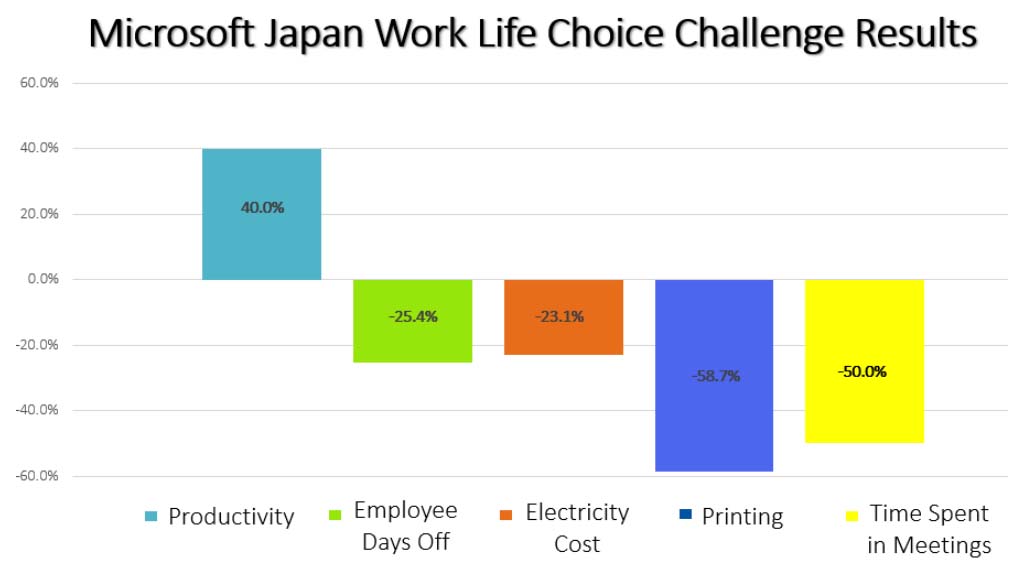
Due to results such as the increase in productivity and decrease in costs, it would be presumptuous to believe that they would have just stoped further implementation of this style of working. This further brings me back to the main issue at hand with switching to a four day work week, and that is that it would cost companies more money and eventually lead them to go bankrupt.
Most companies are not on the scale of Microsoft in terms of the amount of people they employ or the profits they bring in. Yet, in any case, it would be reasonable to assume that even if this were the case, keeping a lower cost of running the business is still in the best interest of the parties that run a company. IF a company were able to cut electricity costs by nearly a quarter of the usual usage and also save on costs such as paper, this could be of great benefit to those who are in charge. In the article “25+ Warehouse Energy Consumption Statistics You Need To Know,” they state that for some companies, electricity can cost a company up to 50 percent of their yearly expenses. If that were lowered, there would be money to be able to higher employees as they see fit, and not be at risk of loosing money. For these reasons, the argument that companies could go bankrupt and effect the economy is almost laughable in comparison to what it would actually provide as benefits that the company owners would gain in return.
References
“25+ Warehouse Energy Consumption Statistics – Meteor Space.” Www.meteorspace.com, 5 Jan. 2023, http://www.meteorspace.com/25-warehouse-energy-consumption-statistics-you-need-to-know/.
Gatlin-Keener, Courtney, and Ryan Lunsford. Four-Day Workweek: The Microsoft Japan Experience. 2019.
Orr, Evelyn. “Microsoft’s Latest Innovation: The 4-Day Workweek.” Www.kornferry.com, http://www.kornferry.com/insights/this-week-in-leadership/microsoft-four-day-workweek-employee-engagement.
Vittert, Liberty. “A Four-Day Workweek Would Destroy Everything That Made America Great.” The Hill, 4 Oct. 2023, thehill.com/opinion/finance/4228933-a-four-day-work-week-would-destroy-everything-that-made-america-great/.


 Counterintuitive Fall 2024