
Working Less Can be a Good Thing
Everyone who is currently working has only known that of a five day work week, but never questioned why that is. I believe that with a little bit of knowledge on the subject and with the way that our world has progressed throughout the years, we should make the leap to a four day work week. Now everyone would love to just cut their work one day short without any repercussions to their pay or hours, but that doesn’t seem realistic. If we look into the history of why the work week is set the way it is we find that prior to the work week mandate in 1927, there wasn’t a set work schedule throughout different industries, and some people would even work “fourteen- to sixteen-hour days, six days per week,” as stated in “Four-Day Work Week: Old Lessons, New Questions.” However, in 1927, many companies and influential CEOs including Henry Ford proposed their own regulations in regard to work time to the Labor Union. After a short trial period, Henry Fords five, eight hour day work week was integrated. This way of work has remained largely unchanged for nearly 100 years.
It wasn’t until nearly 50 years later that people here and there bring up the topic of further decreasing the work week, as we can see in “A Look at The Four Day Work Week” written in 1971. In this paper, it brings to light some of the companies that offer a position with a four day work week. Yet in these positions, you are expected to work 10 hour days, essentially canceling out the shortened week. Due to this, there was a lack of people willing to trade the day off for longer time in the office, and less than 75 thousand workers in the U.S. worked only four days a week. At the time, an 8 hour day was still seen as something that was fought for and rewarded to workers, and to throw that out the window and return to longer days seems counterproductive.
Now, 50 more years later, a “boom” in technology has exponentially sped up most of if not all work done in not only the U.S. but the entire world. With the introduction of the internet, cell services and advancements in machinery, you would imagine the amount of work someone can do today within a week would be equivalent to the work someone in the same position 100 years ago would quite possibly take a month or more to get done. And yet, we still have the same schedule. With these advancements, with the right amount of enticement, most people would even be able to complete a week’s worth of workload in 4 days. What could this enticement be, possibly the same pay and hours, just as long as the completion quality and quantity does not decrease, they would only have to work four days a week.
In a study done in January to December of 2022, 3000 workers of 61 companies participated in a trial of a four day work week. The conditions they proposed were the same as previously stated, complete the same workload in the 4 days of working 8 hours instead of 5 days, and have the quality of work be consistent as it was before. The article called this the “ 100-80-100 model: workers get 100% of the pay for working 80% of the time in exchange for delivering 100% of their usual output.”
On the company side of the experiment, upon completion, 92 percent of the companies stated that they would continue with the four day work weeks. They went on to say that one of these companies was receiving 88 percent more applications for work, and their productivity even increased 22 percent, even though the time at work was shortened. As expected on the employees side, most if not all were overjoyed by the extra day on the weekend. Roughly 90 percent of the employees said they would like to continue with the 4 day work week, while 15 percent of these employees went on further to say that they wouldn’t even take any amount of money to go back to a five day work week.
In more recent news, there have been strikes and employee walkouts demanding 32 hour work weeks while keeping benefits such as wages and healthcare. One example of this is the 13,000 members of the United Auto Workers at three assembly plants in Michigan, Ohio and Missouri. When negotiations with the Detroit automakers didn’t come to a conclusion for a new labor contract, these workers began protesting and going on strike. To the outside and ignorant viewers, it would appear that the workers’ demands are outrageous. When in reality, they are only demanding what should rightfully be adapted with the way the world has steadily progressed.
Why should our employees work almost 100 percent more proficient than that of an individual 100 years ago, and yet work the same amount of hours and days. Hearing it started like this, it seems outrageous just thinking about how when the bill for 5 day work weeks was passed, people would work five days a week at ford for roughly double what was seen as a base salary. In comparison, the people in the same position today are making minimum wage and working the same hours. Yet, the amount of production in the company and stock value of ford has grown exponentially. Not only this example, but it is the same for almost every company out there. And because of this, it should be mandated that work weeks be shortened to 32 hours while keeping every benefit otherwise offered for a full time employee.
Many individuals all over the world have a common goal in mind, that is to work less and earn more. Unless you’re at the top of a prosperous company or born into money, this goal is certainly hard to achieve for the average person. The correlation between the hours that one works and the amount of money they receive has been in place in many companies for over a hundred years. Minimum wages can barely keep up with market inflation and due to this more and more people fall into poverty. The market for jobs is a strenuous one, especially nowadays with more and more college graduates unable to find work due to demands of years of experience in certain fields.
Without work and still having to pay off enormous college loans and miscellaneous bills, many people will find themselves working high demand jobs with low pay just to get by. One of the many jobs that draws these types of individuals in is a delivery driver for companies such as Amazon. The pay is relatively decent compared to minimum wage and you are paid hourly. The kicker though is that you always have a set amount of deliveries per that day. Due to this, the drivers who are more efficient in their deliveries finish faster. That would all be fine if they were not punished for it, and yet due to the pay being hourly and no set hours, the faster you complete the job the less you are paid. This situation has caused many in this position to draw out the delivery process in order to earn more, and be less productive. This also implies that if two drivers had the same amount of deliveries but one driver took twice as long to finish the task, they would be getting paid double the more efficient driver.
This doesn’t completely justify the fact that working longer hours is never better than working faster. But what it does do is bring up the idea of efficiency in one’s work. Unlike a retail worker that will work a set shift from opening to closing, many jobs out there are more or less work until the job is complete. In this type of work, as long as it is completed to the satisfaction of the company, the workers will be paid their wages for the time they put in. If it is completed in 40 hours, they receive 40 hours of pay, 30 hours will earn them 30 hours of pay. Even if the job were to have been the exact same task. In the article “The $2,000 Hour: How Managers Influence Project Performance Through The Rework Cycle”, the rework cycle is a chart in place to roughly manage the work done. It compares the amount of work completed to the quality of said work. The comparison of work time and quality work hours is what’s demonstrated by this chart. As the article stated, employers would pay nothing for the hours put in where workers had not performed well, and thousands for the hours that had actually made progress on their project. In this case unlike the delivery drivers, working less, yet actually being efficient and thorough is rewarded.
Of course, the position in a corporate chain like the ladder is very much different than an entry level job at a delivery company or similar jobs. Yet in both cases the work is performance based. Why is one rewarded and the other punished for being efficient and productive? The problem is that in the system we have in place, the correlation with money earned and time spent at work have been so indoctrinated into the way we live we wouldn’t even think to question why a 9 to 5 job is so common. Work 8 hours, get paid for 8 hours of work. In many cases, the average worker is not slaving away for 8 hours, and maybe gets 5-6 solid hours of productive work done at that time. There is a point in which working tirelessly long hours hinders work performance, in which quality diminishes. If companies were to offer incentives to those who produced quality work for the entirety of their time on the job, this may not be the case. If your house has a leak and you need someone to fix the roof, would you choose a person who offers work for an hourly rate, or someone who has a fixed price. In most cases, the person with the fixed rate. Why? The price may seem a bit much, for example if the fixed rate was 220 dollars compared to the company that offers 80 dollars an hour. The fixed rate may be finished in only two hours, and seemingly you paid 110 dollars an hour. But for someone offering an hourly rate, they would have worked less efficiently and taken 3 hours. Therefore you are paying 20 dollars more than the fixed rate.
Efficiency and quality are the only things that should be considered when being paid. If a company were to offer a position where you work less hours and are paid the same amount, then the question of work quality and efficiency come into play. As in the previous examples, this is very much prominent, as work is more or less on the employees time. Rarely are employees left with overdue work and not enough time to complete it, and on the flip side, many people are dragging out their work in order to receive the pay that they deserve. If companies had greater incentives to employees, this would not be the case, and efficiency would skyrocket.
One of the lead arguments protesting the shortening of the work week is brought to light in an article written by Liberty Vittert called “A Four Day Work Week Would Destroy Everything That Made America Great.” In this article Vittert states that due to the shortening of work weeks, companies that offer customer based services would have on less day of reaching the customer and being able to make sales. Due to this, those same companies would have to hire more help during the active days to make up for the lost day. This would further burden the company for having to spend more money on the extra help, and could eventually cause the company to stop making profit all together and inevitably lay off all work and go bankrupt.
An example Vittert gave of this was a short period of time between 1988 and 1996 in Japan. The work week was shortened form “46 hour to 30 hours” and as a result, the economic output fell nearly 20 percent. Though in the article, Vittert fails to explain the main reason for the economic crisis in Japan at the time. In “The Japanese Economic Crisis of the 1990’s” by Naoto Ohmi, Ohmi talks on the important factors that played into Japans economic downfall of the time. Ohmi talks on a subject known as asset price bubble in which the prices of stock and real estate had been greatly inflated. Due to this there was many who took out loans and with the banks giving little to no regard to whom they distributed money to, they had grossly devalued the price of their yen which led to the economic struggle at the time.
Vittert goes on later to say that Microsoft had implemented a four day work week for a trial period in one of the Japanese offices. In that span, which was only for the month of August, the workers had the Friday off work, and productivity for that month was reported to have increased by 40 percent. The counter argument Vittert gave in this case was that it was due to the month having been a low productivity summer month and that if it were really to be the case then why have they not implemented this style of work week into other branches.
This claim can also be refuted by the author of “Microsoft’f Latest Innovation: The 4-Day Work Week,” Evelynn Orr. In the article Orr, states that due to the success of the trial, they will be doing more trials throughout the months due to the fact that a mone month trial is limited. Throughout the trial, it was stated that paper used for printing was down 60 percent and electric usage was down 23 percent in cost. This is further backed by the results published on an in depth analysis of the trial called “Four-Day Workweek: The Microsoft Japan Experience” written by Courtney Gatlin-Keener and Ryan Lunsford. The results spoke of are shown in a graph provided by the article.
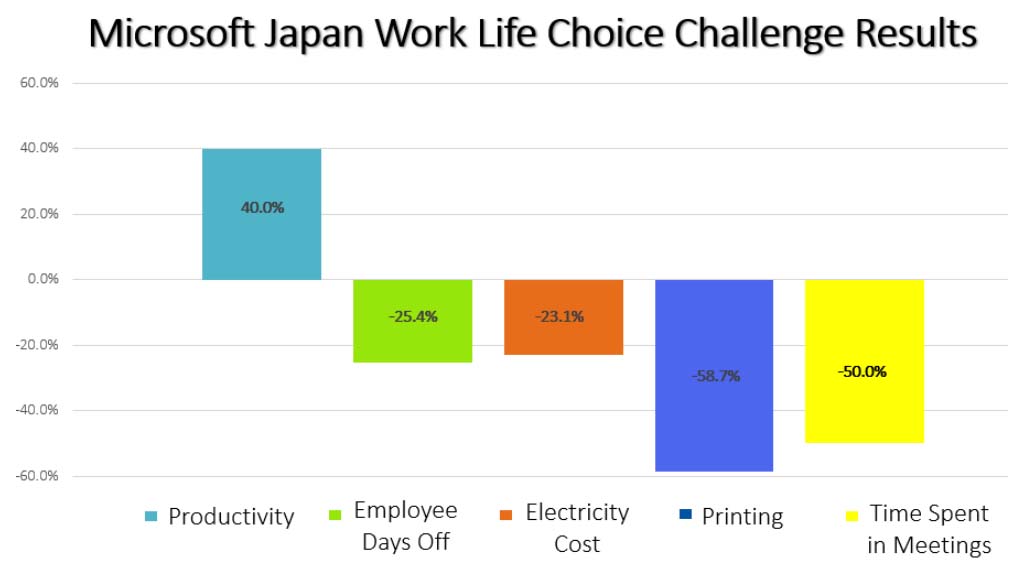
Due to results such as the increase in productivity and decrease in costs, it would be presumptuous to believe that they would have just stoped further implementation of this style of working. This further brings me back to the main issue at hand with switching to a four day work week, and that is that it would cost companies more money and eventually lead them to go bankrupt.
Most companies are not on the scale of Microsoft in terms of the amount of people they employ or the profits they bring in. Yet, in any case, it would be reasonable to assume that even if this were the case, keeping a lower cost of running the business is still in the best interest of the parties that run a company. If a company were able to cut electricity costs by nearly a quarter of the usual usage and also save on costs such as paper, this could be of great benefit to those who are in charge. In the article “25+ Warehouse Energy Consumption Statistics You Need To Know,” they state that for some companies, electricity can cost a company up to 50 percent of their yearly expenses. If that were lowered, there would be money to be able to higher employees as they see fit, and not be at risk of loosing money. For these reasons, the argument that companies could go bankrupt and effect the economy is almost laughable in comparison to what it would actually provide as benefits that the company owners would gain in return.
References
“25+ Warehouse Energy Consumption Statistics – Meteor Space.” Www.meteorspace.com, 5 Jan. 2023, http://www.meteorspace.com/25-warehouse-energy-consumption-statistics-you-need-to-know/.
Cooper, Kenneth . “The $2,000 Hour: How Managers Influence Project Performance through the Rework Cycle.” Project Management Journal, vol. XXV, no. 1, Mar. 1994.
Gatlin-Keener, Courtney, and Ryan Lunsford. Four-Day Workweek: The Microsoft Japan Experience. 2019.
Hedges, Janice Neipert. “A Look at the 4-Day Workweek.” Monthly Labor Review, vol. 94, no. 10, 1971, pp. 33–37, http://www.jstor.org/stable/41838141?casa_token=8J-mzxCxzDcAAAAA%3AYF9QvQZhLVpaFdbRyFzwrwbLdPLU3KW_Uhh6gaGwTCI8dIHNDJvPXwFDGrJOWp_1uk_FRGAkucbb69spWfnN3bOmcr-2oZToHmpBeu6ONKBBcQtWe2M&typeAccessWorkflow=login&seq=1. Accessed 16 Oct. 2023.
Liu, Jennifer. “Workers Report a 4-Day Workweek Improves Health, Finances and Relationships: It “Simply Makes You Happy.”” CNBC, 24 Feb. 2023, http://www.cnbc.com/2023/02/24/worlds-biggest-4-day-workweek-experiment-shows-big-health-benefits.html#:~:text=Employers%20and%20workers%20around%20the.
Orr, Evelyn. “Microsoft’s Latest Innovation: The 4-Day Workweek.” Www.kornferry.com, http://www.kornferry.com/insights/this-week-in-leadership/microsoft-four-day-workweek-employee-engagement.
Peirce , Philip S, et al. “The 4-Day Work Week – ProQuest.” Www.proquest.com, 1 Feb. 1974, http://www.proquest.com/docview/1293721454?pq-origsite=gscholar&fromopenview=true&imgSeq=2. Accessed 11 Dec. 2022.
Vittert, Liberty. “A Four-Day Workweek Would Destroy Everything That Made America Great.” The Hill, 4 Oct. 2023, thehill.com/opinion/finance/4228933-a-four-day-work-week-would-destroy-everything-that-made-america-great/.


 Counterintuitive Fall 2024
Strong work, KJ.
In an A+ paper, as an example, we’d know which of your sources described the following study. We’d also know what sorts of companies were studied, maybe the names of a few of them, where they were located, and how many of the companies (beyond SAYING they INTENDED to stick with the revised schedule) are actually still observing it:
As it stands, this is about 75% convincing that the study was successful and confirmed the efficacy of the plan. To be 95% convinced, your readers would need details and follow-up.
Just an example.