
Before you begin to write your own, you’ll want to review the essential qualities of a good Definition Essay.
1. It’s an argument.
I’ve told you before that all writing is argument, but now is always a good time to remind you. Our intuition might tell us that a Definition Essay is a simple stating of the facts of what a thing is or isn’t. But if that were true, we’d hardly need lawyers at all. Whole libraries have been filled with arguments about whether a particular judicial process is or is not an example of “due process” or “equal protection under the law.” Those categories sound clear enough, but deciding whether individual cases qualify as members of the class is always up for debate.
2. It has real-world relevance.
The dictionary is almost useless in defining what words and concepts mean in society. Because the model essay below is about gay marriage, I looked up the definition of marriage in a 1993 dictionary and found it quite helpless. In several entries, it sometimes refers to unions of husband and wife; sometimes to a special social and legal relationship between men and women for the foundation of a family; sometimes merely to an intimate or close union.
None of these will help us legislate whether same gender marriages should be permitted because, as a society, we get to decide what constitutes a “special social and legal relationship” and who can make one, just as we get to decide what constitutes “the foundation of a family.” After all, we don’t take away the marriage licenses of couples who don’t procreate, even by choice.
3. It often requires defining several terms.
In the above, we need to clarify not just marriage, but social relationship, legal relationship, and family. In the model below, our quest to define the rights of gays seeking to marry sends us in search of good definitions for
- protected class,
- insular minorities,
- laws based on gender,
- laws based on sex,
- invidious discrimination,
- defining characteristics,
- political vulnerability, and
- fundamental nature.
After all that, the model below still doesn’t define marriage, let alone gay marriage. It doesn’t try to. It doesn’t say gay marriage should be embraced. It doesn’t say gays are entitled to all the privileges and considerations of marriage. Its narrower argument is that, whatever gay marriage is, gays belong to a class of citizens entitled to special consideration to determine whether depriving them of the right to marry is unconstitutional.
And that’s a worthwhile definition essay!
In red below are the specific claims relevant to a definition of a protected class that deserves heightened scrutiny and the argument that gays seeking to marry belong to that class.
New York Times Editorial
March 23, 2013
Heightened Scrutiny
One of the central questions in the two gay marriage cases to be argued before the Supreme Court this week is whether gays and lesbians are a protected class under the Constitution. Under longstanding principles, government actions that fall heavily on “discrete and insular minorities” historically subject to prejudice and stigma are to be given particular scrutiny.
The 3.4 percent of Americans who identify as gay, lesbian, bisexual and transgender clearly qualify as this kind of minority. Laws classifying individuals based on sexual orientation — the anti-gay-marriage initiative in California called Proposition 8 and the federal Defense of Marriage Act — must be given heightened scrutiny.
Justice Ruth Bader Ginsburg, then the foremost advocate for gender equality, swayed the court 40 years ago to adopt that standard for gender-based distinctions. The court concluded “that classifications based upon sex” were “inherently suspect.” But it has not yet decided how to treat laws based on sexual orientation. The solicitor general and others argue persuasively that such laws require close review just as those based on gender do.
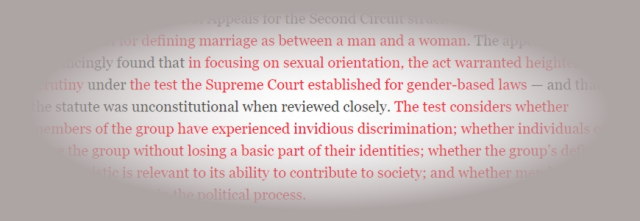
The United States Court of Appeals for the Second Circuit struck down the Defense of Marriage Act for defining marriage as between a man and a woman. The appeals court convincingly found that in focusing on sexual orientation, the act warranted heightened scrutiny under the test the Supreme Court established for gender-based laws — and that the statute was unconstitutional when reviewed closely. The test considers whether members of the group have experienced invidious discrimination; whether individuals can leave the group without losing a basic part of their identities; whether the group’s defining characteristic is relevant to its ability to contribute to society; and whether members can protect themselves in the political process.
Gays, lesbians, bisexuals and transgender people share a common “immutable” characteristic because their sexual orientation is fundamental to who they are and they have indisputably been discriminated against. Until a decade ago, the Supreme Court upheld state laws making “private sexual conduct” between people of the same sex a crime. In the five most recent years for which the government has data, through 2011, hate crimes in the United States fell by 19 percent. But hate crimes based on sexual orientation went up by 3 percent. The discrimination has nothing to do with the ability to contribute to society.
Finally, gays and lesbians, as a minority group, cannot protect themselves from discrimination in a political process governed by the majority. If they had power, Proposition 8 and the Defense of Marriage Act would never have passed, nor would the laws currently on the books in 39 states that specifically restrict marriage to opposite-sex couples.
As the brief for the United States said in the Defense of Marriage Act case, “This is the rare circumstance in which a faithful application of the court’s established criteria compels applying heightened scrutiny to an additional classification.” Neither of the laws in the two cases before the court can withstand this serious constitutional examination.
Brief In-Class or Take-Home Exercise
In a Reply to this page, explain in what way(s) this essay differs from what you thought a Definition/Categorical essay would look like. Then describe one strategy of a D/C essay you might try in your own paper.


 Counterintuitive Fall 2024
You’re exactly right about “depression,” Sunflower, and the reason is pretty simple: the medical community has tried to use a common term as a medical diagnosis. Every reader thinks depression means sadness because depression DOES MEAN sadness.
I used to think that a definition essay was used to describe something (hence the name “definition essay.” While reading this I realized that I did not understand it completely. I learned that the author utilizes their reasons as to why the point of view of the argument is correct instead of defining what something is. They try their hardest to convince the reader and persuade them that what they think is the correct thing/way. Most of the time they barely even use facts! This type of essay is way different then I though it would be.
Your own Definition Essay may very well depend heavily on data, facts, citations, puffer. Every essay is different. But I’m glad you picked up on the fact that a good one, such as this example, is an ARGUMENT designed to prove a point. Newspaper Editorials notoriously deliver the OPINIONS of the editors, leaving the reporting of facts to the rest of the newspaper, but the allusions the essay makes to the law and the history of minorities could absolutely be reinforced by evidence if you were to adopt this style to your own terms.
I used to think that a definition essay was a straightforward and factual paper, created to deliver information. I didn’t really consider there needing to be an argument made or trying to persuade an audience with it. One strategy I might try in my own paper is the use of multiple definitions that interact to support a central argument. For example, the article defines not just the main concept but related terms like “invidious discrimination” and “political vulnerability” to build a more comprehensive case for why certain groups deserve special legal consideration. Taking an approach like this for my own essay would help contextualize the main concept and strengthen my overall argument.
This essay differs from what I thought a Def/Cat essay would look like because you don’t need to define particular terms blatantly. In the example, it doesn’t define marriage or gay marriage, yet focuses on whether gay marriage rights or the deciding of if they should have them, is even constitutional. Rather, the argument is determining what is or is not constitutional towards this protected class’s rights. This is an argument crafted to prove a point.
One strategy I may try in my D/C essay is making my argument know. Rather than just throwing facts at my audience, I’d instead use them to prove my point. Highlighting terms that build a strong foundation of my point reconnecting to my thesis
The essay itself is not straightforward, yet it alludes to what they are trying to define. It doesn’t tell you exactly what they are trying to tell you. It uses information that you ready to give definitions along the way to reaching what they are contextualizing. I find it interesting using many examples to slowly get themselves to the point, rather than just telling you why this argument is there. It places the context there instantly, while not telling you what exactly where that context is used. I believe that it’s an interesting way of writing, and that using the multiple amounts of claims to support the large one is a great way of easing your way into the point you are attempting the reader to reach.
It differs from what I expected it to look like by alluding to the claim it is making rather than directly stating it. It also differs by using the opinions of others in it.
This essay is different from what I thought a definitional/categorical essay would look like because it doesn’t just state the definition or what something means directly in the text. It ends up explaining as the essay is written. I thought we should add directly what something means in order for the audience to understand. A strategy I may try in my own essay is defining my work with evidence as I write it. As I write my essay I will include facts(evidence) that will help prove my point as well as define what is going on. Instead of blatantly writing what a specific word/thing means.
I’m not good at trying to get to the point without defining certain terms because I intend to be brief and descriptive of what I wanted to say and explain so that my readers understand certain terminology throughout my essay. I’m the type of writer who likes to use a lot of evidence to back up my claims instead of blurting things out of what I’m saying is true or not. I also like to use statistic numbers to back up my claims so that it’s not like these numbers just appear out of thin air.
This essay is different from what I thought a Definition/categorical essay would look like because it is not straightforward and doesn’t state something clearly in the text. I usually don’t use that in my writing, like I usually make my point and move on to the next subject/topic.
One strategy that I will try to use in my writing will be actuating making it an argument. I think since my essay is about human emotions I will have to revise a bit with the professor to really find what argument I am trying to make arfd how.