
Behind the Veil
As we enter a time when the public demands that corporations both be economically sustainable and make environmental improvements, companies are cracking under the pressure to keep up. Chevron, Exxon/ Mobil, BP, and other massive contributors to carbon emission pollution, attempt to hide their planet-killing practices from the public through “greenwashing,” highlighting small environmentally beneficial practices to divert attention from their assault on the planet we all depend on to sustain human life. Companies are trying to shift towards being eco-friendly businesses where consumers are comfortable with spending their money but are lacking transparency to what happens behind the scenes.
It should be no surprise environmental changes need to be made; global warming has been on the rise for quite a while now, since the 1950s to be specific. As the world continues to develop, mass production also continues to “help” with all of the technological advancements. This is what birthed large companies, leading to uncontrollable pollution that is becoming irreversible. According to the Carbon Disclosure Project, a non-profit that manages environmental impacts, just 100 companies are responsible for 71 per cent of greenhouse gas emissions alone. We cannot argue the facts, the large fossil fuel companies are the problem, and the greenwashing is hard to decipher from the truth.
A major contribution to greenwashing is the government turning a blind eye when companies outright lie to the public. For instance, one of the largest, and widely used oil companies in the United States, Chevron, has been in the spotlight for quite some time because of their mass contribution of greenhouse gas emissions in the atmosphere. They contributed 697 million tons of CO2 togreenhousegas emissions according to Client Earth’s greenwashing files in 2019. Since being exposed, they have promised to progress towards a low carbon future by 2050 but have only been putting .2 per cent of their capital towards this project between 2010-2018. They are fabricating any promises they have made by putting pocket change into their goals. This is possibly one of the worst greenwashing cases we have seen, but the National Pollutant Discharge Elimination System claims that Chevron “remains in compliance with federal, state and local water regulatory standards.” It would be hard to believe that the people in power are not working for the best interests of the people, but the evidence proves their neglectful behavior.
Many companies have started to share similar goals that want to produce fewer damaging products by using recyclable materials such as rPET (recyclable polyethylene terephthalate). This material is versatile and sustainable, so numerous companies are trying to get their hands on it to reach their recycling goals. Karen Ho says in her sustainability article, “To meet the recycling goals of US beverage brands, an estimated 1.1 billion pounds of food-grade rPET will be needed in the next decade — almost three times the amount produced in 2017.” The problem with a rise in demand is also the price rises, which causes companies to back away from sustainability claims. When it comes down to money or the environment, money is prioritized. Companies start to fabricate what materials they are using to appeal to consumers and save their money.
A material that is cheaper than rPET is Virgin Polyethylene terephthalate (vPET), a plastic manufacturing material that is in its purest form. Robin Hicks states in his article that vPET has fallen to $500-600 a ton while rPET is double the price around $1,000 a ton. This price gap encourages companies to take the cheaper way out by using one time use plastics and claiming them to be recycled materials. According to Dr. Steve Wong, “it’s also hard for companies that buy polymers to use in their packaging to distinguish between the plastic types without laboratory testing.” This testing could prove the authenticity of the plastic companies’ claim to use, but it is near impossible to test every individual item made. One example is ensuring beverage bottles that are labeled as recycled plastic, like Coca-Cola, are truly recyclable. When diving into further research, only 25 per cent of the bottle is actually recycled plastic while the 75 per cent that remains is Virgin Polyethylene terephthalate (PET) according to Beth Newhard in her article, “Plastic vs. Plastic: Which Packaging is Best. Companies use vPET material to greenwash their consumers into thinking their products are being recycled, but really have ended up in landfills, adding to the mass of pollution that ends up in our atmosphere.

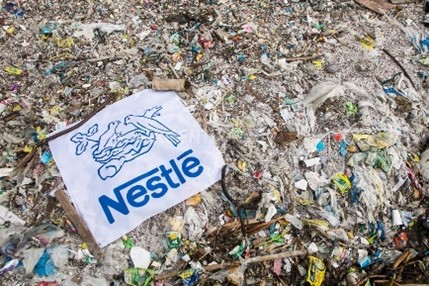
Environmental credentials are made by many companies, but not all of them reach the high bar that they set for themselves. One of the biggest food distributers, Nestle, has been named the top plastic polluters in the world for three consecutive years according to “Break free From Plastic” 2020 annual report. This has led them to promote their “ambitions” about being 100 per cent recyclable by 2025, but the campaign was not backed with any proof. Nestle’s form of greenwashing is subtle but there, they claim they are moving towards being recyclable but have no existing targets to hit according to Perry Wheeler in his “Greenpeace” article. A large company that contributes to this much waste for many years should have a bigger plan than just feeding the public outright lies through their campaigns.
The numerous companies that are relying on greenwashing to appeal to their audience has increased in recent years. Consumers want to see changes made in their campaigns that show they are willing to switch to eco-conscious habits even though it takes some muscle. Fabrication, outright lies, and propaganda are the only appropriate terms to use when referring to the countless greenwashing campaigns that have been exposed and that are continuing to be investigated. Companies promote misleading environmental sustainability efforts that are actually hiding the public from the harsh truths of destructive business practices.
By promoting their misleading sustainability efforts, companies greenwash their image to hide their environmentally destructive business practices from the public. They divert the market’s attention toward a positive achievement, large or small, to distract consumers from their contributions to pollution. The misleading social media and news campaigns keep the public ignorant of their real investment into their planet-killing activities. The planet pays the price for corporate propaganda.
An issue we are seeing with fossil fuel companies is not only their pollution, but also their donations to colleges who are conducting climate research. If we continue to let fossil fuel companies donate to research projects that contradict their business, we continue to let them have the upper hand in what is actually allowed to be studied. These enormous donations to research groups do not go unnoticed so the companies specifically want the donations they made to be publicized so consumers think they are working towards a greener future, but sadly they just want to take control. In a Yale Climate Connection interview, Bella Kumar, a Fossil Fuel research student at George Washington University, “funders can influence which topics are studied. And in some cases, they influence how results are framed, for example downplaying the negative impacts of burning fossil fuels.” Throwing money around is the easiest way for companies to lie about their intentions and continue emitting fossil fuels into the atmosphere.
When people see positive promotions from their favorite companies planning environmentally friendly efforts, the more greenwashing the companies are able to get away with. Polluters make promises in these campaigns that they do not intend to keep. They are unleashing advertisements for their green campaigns with no actual concrete evidence to support it. By making vague claims saying that they have ambitions to move towards being net-zero, they are secretly granting themselves years of good grace until they return saying their ambitions failed. There is a difference between making a pledge about what you want to achieve, and taking meaningful actions that will actually take you there.
“Companies should be saying exactly how they’re going to reduce their emissions all the way to zero, if they have to rely on offsets — where are those offsets coming from? How credible is the offset company that they’re working with?”
If offsetting is a solution to their own pollution problem, it is clear that these companies have no intention of making needed changes to their own habits. They think paying another company to fix their problems offsets their own pollution, which it does not. If companies continue to use offsetting as a “solution” to their own problems, then their pollution will cause irreversible damage much quicker. According to Angel Hsu, data scientist and founder of Data Driven EnviroLab, if companies are being secretive about their plans to reduce their emissions, then there is likely no plan at all.
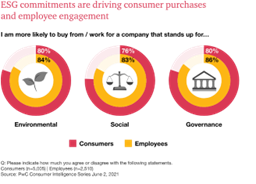
Since the COVID-19 epidemic, companies have depended more than ever on promising to work toward open-ended goals to earn customer loyalty. “While consumers have long said that they value sustainability, the COVID-19 crisis perceptibly shifted consumer behavior and enlarged the pool of conscientious consumers willing to pay more for healthier, safer, more environmentally and socially conscious products and brands,” according to PwC research team. Having said, companies do not want to lose their customers because they do not have a plan that involves them moving to net-zero emissions, so developing open-ended goals is the best way to appease consumers for the short-term. Companies pulling publicity stunts to keep their business flow going is only putting off the inevitable of eventually being exposed for nonexistent goals. The cycle continues to go around and around with greenwashing.
A recent tactic from fossil fuel companies is silencing protests that fight against them. Protestors have been attempting to exploit these reckless companies and break the silence on how they are the reason for climate change. Companies can lie about what they are doing behind the scenes, but when it comes into the vision of the public, there is little they can do, or so we think. In Nina Lakhani’s anti-protest research, she interviewed Greenpeace director, Ebony Twilley Martin, who claims, “We are seeing an escalation of tactics to criminalize, bully, and sue those working for climate action, Indigenous rights and environmental justice… [as] oil and gas companies find new ways to delay the transition to clean energy and protect their own profits.” With fossil fuel companies silencing the voices of the public, there is little ways to spread awareness of the damage they are doing to the planet. With over 250 anti-protest bills in place, these environment activists are facing life-altering risks to try and continue the fight against fossil fuel companies and their destruction.
Fossil fuel companies are fighting against the people in order to keep their cash flow going. Greenwashing is not a singular tactic but an array of techniques that include lies, intimidation, deceitful research, vague goals, and happy talk, among others. These sneaky tactics allow them to continue being vicious towards our environment. They are working tirelessly to keep their destructive pollution in the dark, and it is working. Uncovering the lies is the first step to take down greenwashing and the reckless pollution it brings.
Now, more than ever, the world is seeing a climate crisis in full effect, and we need to do a quick 180 before it is too late. Even though companies understand that their contribution to irreversible damage needs to be addressed immediately, they are still snapping back at criticism from the public. The problem that corporates are facing is being exposed in the news for their lack of progress towards the environmental sustainability claims they have made.
Nestle did not make a rigorous plan that had clear goals to achieve and correct their destruction. Their lack of transparency hints toward them greenwashing the public to keep us quiet while they continue to destroy our planet. Georgina Rannard in a BBC News article describes the situation in which Nestle feels under attack for their lack of substance of efforts to reduce climate change by picking on the reporters from the New Climate Institute’s Corporate Climate Responsibility Monitor (CCRM). “Nestle commented: ‘We welcome scrutiny of our actions and commitments on climate change. However, the CCRM report lacks understanding of our approach and contains significant inaccuracies.’” Nestle is clearly irritated with the news, but if the claims are inaccurate, Nestle would be less reluctant to release their successes to the world. This just means they likely have no goals or progress to share. Mark Schneiders includes Nestle’s ambitions for climate change in his article, “Nestlé CEO: We don’t have to sacrifice shareholders to fight climate change.”
“Nestlé operates in nearly every country in the world, and the decisions we make can drive change in the food industry. We do not take that responsibility lightly. We have never wavered in our support for the Paris Agreement—no matter how the political winds have shifted—and we have publicly detailed our commitment to halve our greenhouse gas emissions by 2030 and to achieve net-zero carbon emissions by 2050.”
Perry Wheeler, in his Greenpeace article, emphasized, “The statement is full of ambiguous or nonexistent targets, relies on ambitions’ to do better, and puts the responsibility on consumers rather than the company to clean up its own plastic pollution,” while he discusses how Nestle fails to hit their very far-reaching targets.
In an article published by Underwriters Laboratories Solutions, they identified the seven sins of greenwashing that simply explains the tactics companies are using to get by. The seven sins are: hidden trade-offs where the company admits to doing something bad but offers something good for balance. The lack of proof in which a company offers unsupported claims of having achieved green goals. Vagueness, in which is so poorly defined that there is room for misunderstanding with consumers, allowing the company not to be held down to claims. Worshipping false labels, in which a product has words or images that give a nonexistent 3rd party endorsement. Irrelevance, when a claim is made but it is unimportant to the environmental efforts. The lesser of the two evils, when a claim can be true but is used to distract consumers from worse catastrophic impact. Lastly, fibbing, where claims are outright false that claim to be certified. A fine list, to which I will add one I have seen more often than any other, the sin of making unrealistic predictions. A majority of the companies I have researched have committed this sin while developing sustainability claims because they are just unattainable with the current position they are in; for example, Nestle.
The article states that “based on the results of the original study and subsequent studies, the Seven Sins of Greenwashing were developed to help consumers identify products that made misleading environmental claims.” In the case above, Nestle takes part in the sin of no proof and vagueness, encouraging the public to conclude that they are making changes. The circumstance they were put in should have been forceful enough to share all the great work and progress taking place, but instead it just proved that their vagueness and lack of proof is massive greenwashing.
Since all this backlash from the public on companies such as Nestle, other companies are starting to feel the heat as well. Specifically, BlackRock investment company, the second largest fossil fuel contributor in the world, has been receiving pressure from the public to release their ambitions about investing with companies who are not making environmental changes. Larry Fink, the CEO of BlackRock, responded, “BlackRock argues that its investments are consistent with a commitment to a responsible and orderly — rather than recklessly rushed — energy transition, as well as the realities of global energy needs after Russia’s invasion of Ukraine.” Fink’s response was clear, he is staying invested in fossil fuel companies until the world proves it can do without them. His pushing off of a response to the public and becoming defensive that his company and he are being “recklessly rushed,” proves that he stands against the green side and stands with planet extinction habits. BlackRock, and their billion-dollar investments, plan to continue supporting fossil fuel companies because crippling the industry would be disastrous. They will continue with funding, and these businesses’ destruction will continue to expand.
“On the issue of climate change, BlackRock has sought to strike a balance, continuing to invest in fossil fuel companies while nudging them to adopt energy transition plans. It has projected that by 2030 at least three quarters of its investments will be with issuers of securities that have scientific targets to cut greenhouse gas emissions on a net basis.”
Larry Fink is a prime contributor to companies advancing their planet polluting activities because he is the one who funds their entire operation. When making claims that still include expansion of mass destruction, public concern should be sparked since he is using terms such as “nudging” when he should be making an ULTIMATIUM. Without the millions and billions of dollars he provides to these companies, they would not survive, so the best action he can take is asserting his dominance in the situation. He should not be ENCOURAGING environmentally positive business practices; he should be mandating them in order for companies to even pursue or continue business contracts with him.
References
Wong, S. & Hicks, R. (2020, May 28). Cheap virgin plastic is being sold as recycled plastic—it’s time for better recycling certification. Eco-Business.
Wheeler, P. (2018, April 10). Nestlé misses the mark with statement on tackling its single-use plastics problem. Greenpeace USA.
Ho, K. K. (n.d.). Companies like Nestle and Coca-Cola are eager to use more recycled material — here’s why that actually raises concerns over long-term sustainability goals. Business Insider.
Hsu, A. (2023, January 10). Data-driven EnviroLab tracks climate action. UNC Global. https://global.unc.edu/news-story/data-driven-envirolab-tracks-climate-action/
PricewaterhouseCoopers. (n.d.). 2021 consumer intelligence series survey on ESG. PwC. https://www.pwc.com/us/en/services/consulting/library/consumer-intelligence-series/consumer-and-employee-esg-expectations.html
Team, YCC. (2023, May 18). The fossil fuel industry is donating hundreds of millions to university climate and Energy Research ” yale climate connections. Yale Climate Connections. https://yaleclimateconnections.org/2023/05/the-fossil-fuel-industry-is-donating-hundreds-of-millions-to-university-climate-and-energy-research/
Halper, E. (2023, May 19). Is BlackRock’s Larry Fink blowing it for the climate? Washington Post. https://www.washingtonpost.com/business/2023/05/06/blackrock-esg-climate-woke/
UL Solutions. (2019). Sins of Greenwashing. UL. https://www.ul.com/insights/sins-greenwashing
Rannard, G. (2022, February 7). Climate change: Top companies exaggerating their progress – study. BBC News. https://www.bbc.com/news/science-environment-60248830
Binnie, I. (2023, June 26). BlackRock’s Fink says he’s stopped using “weaponised” term ESG. Reuters. https://www.reuters.com/business/environment/blackrocks-fink-says-hes-stopped-using-weaponised-term-esg-2023-06-26/


 Counterintuitive Fall 2024
Added into feedback please. At this point I want to make sure my rebuttal portion is good to go (I added that specific short argument in feedback please as well) and see if I should make any adjustments to my full research paper. 🙂
Maybe add the boldface type to the seven sins section, but you don’t really need to make revisions to this fine work except to please yourself. BlogUser.
I added the boldface to the seven sins. I appreciate your help in creating this research paper.
🙂