
For my research essay I will be examining different companies’ ad campaigns about environmental sustainability efforts and if they are fabricated. Greenwashing has been around for many years, but after Covid, it has grown a substantial amount with large companies. Many companies are experiencing what researchers refer to as growing pains because consumers want to take part in an eco-friendlier society to decrease pollution and brands just cannot keep up. Brands’ quick solution is to make promises they cannot keep or just blatantly lie to keep customers coming back. We have seen this in numerous brands that include fashion, vehicles, furniture, and bottle brands. With the amount of pollutants these companies are putting into the atmosphere, it is necessary that they keep being exposed for greenwashing and consumers stop supporting them until they do.
1. Hicks, Robin. (2020, May 28). Cheap virgin plastic is being sold as recycled plastic—it’s time for better recycling certification. Eco-Business.
Background: This article provides sources about companies lying by using cheaper virgin plastic with recycled plastic and advertising it as “100% recycled plastic” in order to draw in consumers from being “economically sustainable.” After Covid, the price of virgin polyethylene terephthalate (PET) has dropped significantly which is a temptation for companies to use it because of its similarities to recycle plastic. Without laboratory tests, it is hard to tell what the companies are using.
Incorporation: I used this information in my article by explaining the difference between the two plastics and emphasizes the one that is better for the environment. The information from this article supports my argument that companies lie to the public because of the growing pains they face when it comes to being environmentally sustainable. The transparency this company lacks hides their unsustainability and pollution practices from the public, but the lie being exposed shows customers that the company isn’t trustworthy anymore. Having a third-party verification system might be the solution to force companies into being truthful about what they’re using for their products.
Quotes: “In the recycling business, there are people who have benefitted from a lack of transparency for a long time,” he said. – Josse Kunst
“The high price of recycled plastic has tempted manufacturers to mix in much cheaper virgin plastic and sell it as 100 per cent recycled material.”
2. Rannard, G. (2022, February 7). Climate change: Top companies exaggerating their progress – study. BBC News.
Background: This article provides in detail what multiple big companies have promised to increase efforts in becoming environmentally sustainable. One in particular was Nestle, a big food company who has made promises to reduce their carbon footprint by 2030. The sustainability rankings for companies expose whether they have been progressing towards their claims, or if it was just lies for when the cameras are rolling. The sin of making unfulfillable promises is exposed by the CCRM monitor and companies must make progress in order to be higher up on the list.
Incorporation: I used this article in my rebuttal argument to support that companies come up with unrealistic promises in their campaigns to people please but have no real intentions of fulfilling their goals (the sin of making unrealistic predictions). I used specific information from this article that shows Nestle snapping back at their rating on the CCRM monitor. Since they were put into the spotlight, the public would think to see some evidence that proves the article’s inaccuracy on their failing goals, but they have not published anything in response to the critics.
Quote: “Nestle commented: ‘We welcome scrutiny of our actions and commitments on climate change. However, the CCRM report lacks understanding of our approach and contains significant inaccuracies.’”
3. Schwenk, C. (2022). Sustainable or greenwash? An analysis of how fast fashion brands use Social Media Marketing.
Background: In this research paper, I have found that clothing brands are using what is called, “the 7 sins of greenwashing.” For example, the clothing brand Mango uses greenwashing on their Instagram pages when pushing out their so-called sustainable collection, but really most of the clothing did not come from the cellulose fibers it claimed. The article referred to this as, sin of trade-off, or in other words the brand was lying about the materials they were using. Pg.39
How I would have used this: I would have used this piece to show how companies create false advertising just so they can get more publicity for their product to sell.In this case it’s fashion, which adds 8-10% to the world’s carbon emissions and to 20% of wastewater according to Mark Brewer in his promoting sustainability article. (article link below) I did not use this EXACT article because I did not include fashion and materials in my paper, again was aiming more for fossil fuels and emissions in the atmosphere. I used a similar article about the 7 sins of greenwashing, it is somewhere in the list below.
Brewer, M. K. (2019). Slow Fashion in a Fast Fashion World: Promoting Sustainability and Responsibility. Laws, 8(4), 24. MDPI.
4. Pizzetti, M., Gatti, L., & Seele, P. (2019). Firms Talk, Suppliers Walk: Analyzing the Locus of Greenwashing in the Blame Game and Introducing “Vicarious Greenwashing.” Journal of Business Ethics, 170(1).
Background: This article discusses what greenwashing is and it explains why companies participate in it; they are trying to appeal to consumers as well as dodge penalties from higher ups like the government. Defines that indirect greenwashing is when a company is in communication with being more sustainable but working with an external supplier that is not, by buying and using their products.
How I would have used this: I did not use this article because I did not end up arguing against indirect greenwashing. If I did, I would have questioned if companies declare they are going green, but buy (and support) a supplier that is not on the same page, are they still economically sustainable? I would have argued against it because the company is attempting to decrease their carbon footprint, or even try to be net neutral, they would try and find another reliable source that also wants to achieve this. If not, they are still contributing to pollution because they are putting money towards a business that neglects our environment.
Quotes:
“We expect that, when a declared control of the supply-chain is present, a company culpable of indirect or vicarious greenwashing is perceived as also being accountable for the supplier’s actions. Such expanded accountability leads to greater blame.”- section H1
“Moreover, if the misbehavior is not controllable by a company, then a company can adopt a sustainability standard in order to force a supplier to act sustainably, or it can select more sustainable suppliers.”- section H3
5. Hotten, R. (2015, December 10). Volkswagen: The scandal explained. BBC News.
Background: A popular German car brand, Volkswagen, was caught with false advertisements on their supposedly “clean car” campaign that was aired in many places including the Super Bowl ads. The FTC (Federal Trade Commission) caught Volkswagen cheating on government emissions tests with a defeat devise that covered the amount of emissions the car spewed out, which was actually 40 times over the legal limit. More than 550,000 cars were sold to consumers who thought they were getting sustainable cars to help the environment but really were a part of a scheme for the company to put a pretty high price tag on these vehicles.
How I would have used: I would have used this in my paper to argue that these companies are using big ad campaigns, including Superbowl’s, social media campaigns, and print advertising to greenwash people into thinking they are moving towards sustainability growth, but really are out to make a quick buck. By doing this they hit their target market of “environmentally conscious” consumers by taking advantage of them through the biggest ad campaigns. Not only is the pollution getting worst, but the consumers are also losing their money. I did not use this article because I did not find a beneficial place for it.
Quotes:
“The campaign slogans included claims that the VW Jetta diesel “reduces nitrogen oxide (NOx) emissions by up to 90 percent,” and that the Audi TDI engines emit “fewer NOx emissions than comparable gasoline engines,” and “meet the strictest EPA standards in the U.S.”
“As a result, consumers didn’t get the benefit of the environmentally friendly car they thought they were purchasing, and resale values likely will fall.”
6. Auckland, U. of. (n.d.). COVID has changed how people view the environment and their relationship to it. Medicalxpress.com. Retrieved October 18, 2023.
Background: The studies this team took part in were to see if people’s view of the environment had changed after experiencing the world-wide lockdown from the COVID-19 virus. During the pandemic only a 1/3 of people were really concerned with the environment, but as the pandemic went on, people’s minds started to change. People with even the lowest interest in the environment were concerned about all the waste including masks, hand sanitizer, waste, etc. that the planet was enduring.
How I would have used: I would have used this in my definition argument to introduce why the sudden interest in the environment occurred. This will further explain why more companies are turning to greenwashing because they cannot keep up with what their consumers are asking for. I did not end up using this because it was unnecessary to introduce why people were interested in green plans. I found better material to incorporate into my argument.
Quotes:
“For example, we found that even those with a low interest in the environment were concerned about the negative impacts of COVID on the natural world [plastic waste, masks, packaging, hand sanitizer].”
7. McVeigh, K. (2020, December 7). Coca-Cola, Pepsi and Nestlé named top plastic polluters for third year in a row. The Guardian.
Background: The article discusses how the large food distributor, Nestle, is one of the leading companies that contributes to high levels of plastic pollution in the world. After being exposed on Greenpeace list of worst companies contributing to such pollution, they released their “ambitious” of wanting to be 100% recyclable by 2025 with no evidence of actually creating a plan to accomplish this.
How I would have used: I would have used this to build an argument around companies doing “baby greenwashing” that we don’t seem to question. With this company being one of the largest polluters, more evidence of a plan is needed so consumers know whether there is realistic progress to be made. Since they do not have a constructed plan, the claims they are making are fabricated lies to ease the public’s concerns about wasteful production.
8. PricewaterhouseCoopers. (n.d.). 2021 consumer intelligence series survey on ESG. PwC.
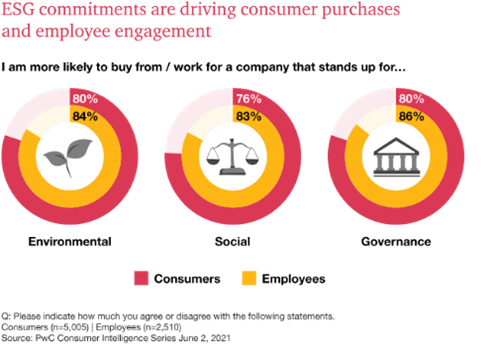
Background: This is a survey conducted by PricewaterhouseCoopers that shows employees and consumers are attracted towards companies who are providing a safer and more environmentally friendly workplace and business. The study proves that there is a large percentage of people who look for a good ESG (Environmental, social, and corporate governance) when deciding where they should spend their money.
Incorporation: I used this study in my causal argument to show that consumers do look for good ESG within companies, so it can be alarming for companies who have not made changes. The fear of losing consumers is in the companies’ mind, so it pushes them to greenwashing rather than actually solving their large pollution problems. Keeping the money flowing is more important than anything else.
Quotes: “While consumers have long said that they value sustainability, the COVID-19 crisis perceptibly shifted consumer behavior and enlarged the pool of conscientious consumers willing to pay more for healthier, safer, more environmentally and socially conscious products and brands.”
9. Wheeler, P. (2018, April 10). Nestlé misses the mark with statement on tackling its single-use plastics problem. Greenpeace USA.
Background: Perry Wheeler tears up Nestle for having nonexistent targets when it comes to reaching their goal of net zero by 2050. He claims that their lack of transparency indicates the use of greenwashing to hold off the public’s critiques for a little longer. When their statement is full of nonexistent targets and ambitions it is hard to believe they have any plan at all.
Incorporation: I used this argument in my causal and rebuttal argument to reiterate that Nestle is not holding themselves accountable for their pollution. Nestle is a huge food company that demonstrates the perfect scenario of “we are trying our best so stop breathing down our necks.” This is a type of greenwashing because they are trying to divert the attention away from their company instead of releasing any progress. Since they have no publication of clear guidelines to meet their goal, it is hard to believe that they are in the process of doing anything at all.
10. UL Solutions. (2019). Sins of Greenwashing. UL.
Background: The article goes into detail about the 7 sins of greenwashing and what consumers should look for to identify greenwashing. The 7 sins are hidden trade-off, no proof, vagueness, worshipping false labels, irrelevance, the lesser of the two evils, and fibbing.
Incorporation: I added this information into my rebuttal argument to make known the 7 sins that UL solutions have identified for the public. After listing short explanations of each sin, I also added an 8th sin of my own, the sin of making unrealistic predictions. This sin is seen more often than others in the majority of companies simply because they want to make a response to the public when they have no real intentions of fulfilling them. An example of vagueness and no proof is Nestle’s statement because they are missing progression and understandable language. It is important to understand the details that go into these different sins (or signs) to know when companies are greenwashing.
11. Binnie, I. (2023, June 26). BlackRock’s Fink says he’s stopped using “weaponized” term ESG. Reuters.
Background : This article discusses how ESG (Environmental, social, and corporate governance) has become a topic of “war” between different parties. The controversy that the term brings is why companies and CEOs are starting to avoid it. Larry Fink pushed off talking about his expectations for companies he is going to invest in. He basically told the public that going slow and steady was the most responsible rather than recklessly rushing an energy transition.
Incorporation: I used this article in my Rebuttal argument to show that investors greenwashing is just as important to focus on as the fossil fuel companies. Fink has billions of dollars that are invested into fossil fuel companies for their desired use. I will use Fink’s words against him when he said he was being “recklessly rushed.” Since he is still willing to invest in fossil fuel companies who are not making plans and goals to lower their carbon emissions, it is a clear way to know he is greenwashing.
12. Ho, K. K. (n.d.). Companies like Nestle and Coca-Cola are eager to use more recycled material — here’s why that actually raises concerns over long-term sustainability goals. Business Insider.
Background: This article describes the concerns that come with companies trying to increase their recycled material use too quickly (companies need 3x more than the amount needed in 2017). The problem with this is that the long-term sustainability goals will become less doable if the price for recycled material is far too much. Since the demand for materials has increased immensely after policies have been put into place, companies might back away from their sustainability pledges as a result.
Incorporation: I used this article to support my causal short argument. If companies start to back away from sustainability goals from the price increases in recycled material, the public will not realize. The fabrication of what companies are using for their products will grow and the greenwashing will continue. So, when money and the planet is put on the line, companies will always choose the money over correcting their damages.
13. Hsu, A. (2023, January 10). Data-driven EnviroLab tracks climate action. UNC Global.
Background: The Data-Driven EnviroLab was founded by Angel Hsu who is also a principal investigator. She does labs that assess climate action done by companies and regions to see if they are being truthful or its greenwash. Hsu thinks we need to hold companies more accountable for their climate goals to track if any progress is being made because many are just lying. She promotes her Climate TRACE project that tracks individual polluters which shows how much companies are emitting. She has developed, with EnviroLab, the Net Zero Tracker that collects data on companies and evaluates if they are making efforts to save the environment.
Incorporation: I used this article in my causal argument to support that companies need to be checked for their progress rather than just believed. Angel Hsu claims if companies are being secretive about their emission reduction plans, then there is probably no plan at all. Offsetting seems to go hand in hand with this because companies try to solve smaller issues that make it seem like their work isn’t as bad when it is. These open-ended goals need to be exposed and the first step is recognizing when you’re being lied to.
14. Team, YCC. (2023, May 18). The fossil fuel industry is donating hundreds of millions to university climate and Energy Research ” yale climate connections. Yale Climate Connections.
Background: This article by the YCC team includes student researchers expressing concerns about fossil fuel companies being able to donate to research. This research is about the climate and energy, including the harmful pollutants that these companies use. Research student, Bella Kumar, at George Washington University is a part of the Fossil Free Research team. Her and her fellow researchers have found that the fossil fuel industry donated over $600 million dollars to schools conducting research. This is a problem because funders have influence on what topics are being studied and how they are framed. This is a greenwash tactic so fossil fuel companies can get control over the narratives being released. Kumar pushes for fossil fuel funding to be banned so they can get legit research done.
Incorporation: I used this article in my causal argument to help support the fact that companies only fund these research projects to have control over them. The studies cannot go on appropriately if the companies the researchers are fighting against have the final say on what is studied. Bella Kumar says in the article, “funders can influence which topics are studied. And in some cases, they influence how results are framed, for example downplaying the negative impacts of burning fossil fuels.” This is important to note as greenwashing because companies use their money to cover up their harmful emissions to the atmosphere.
15. Halper, E. (2023, May 19). Is BlackRock’s Larry Fink blowing it for the climate? Washington Post.
Background: This article discusses how Larry Fink, the founder of the world’s largest fossil fuel investment company, ignores climate risks. He claims that there is no urgency to “recklessly rush” progress and he’d rather do it “responsibly.” BlackRock’s billionaire leader has no intentions of pulling his money out of fossil fuel companies that do not have environmental sustainability plans. The only plan for BlackRock is to be the biggest asset manager in the world regardless of environmental risks.
Incorporation: I used this article to support my rebuttal short argument. Larry Fink’s response to the public is a form of greenwashing because he is funding companies’ pollution projects. “BlackRock argues that its investments are consistent with a commitment to a responsible and orderly — rather than recklessly rushed — energy transition, as well as the realities of global energy needs after Russia’s invasion of Ukraine.” Fink’s response about being recklessly rushed is major red flags for greenwashing because he has no intentions to stop his investments, and the public needs to continue to apply pressure for change. His plan is to “nudge” companies to make energy transition plans but is not making the necessary ultimatums.


 Counterintuitive Fall 2024
Spectacular work, BlogUser.