

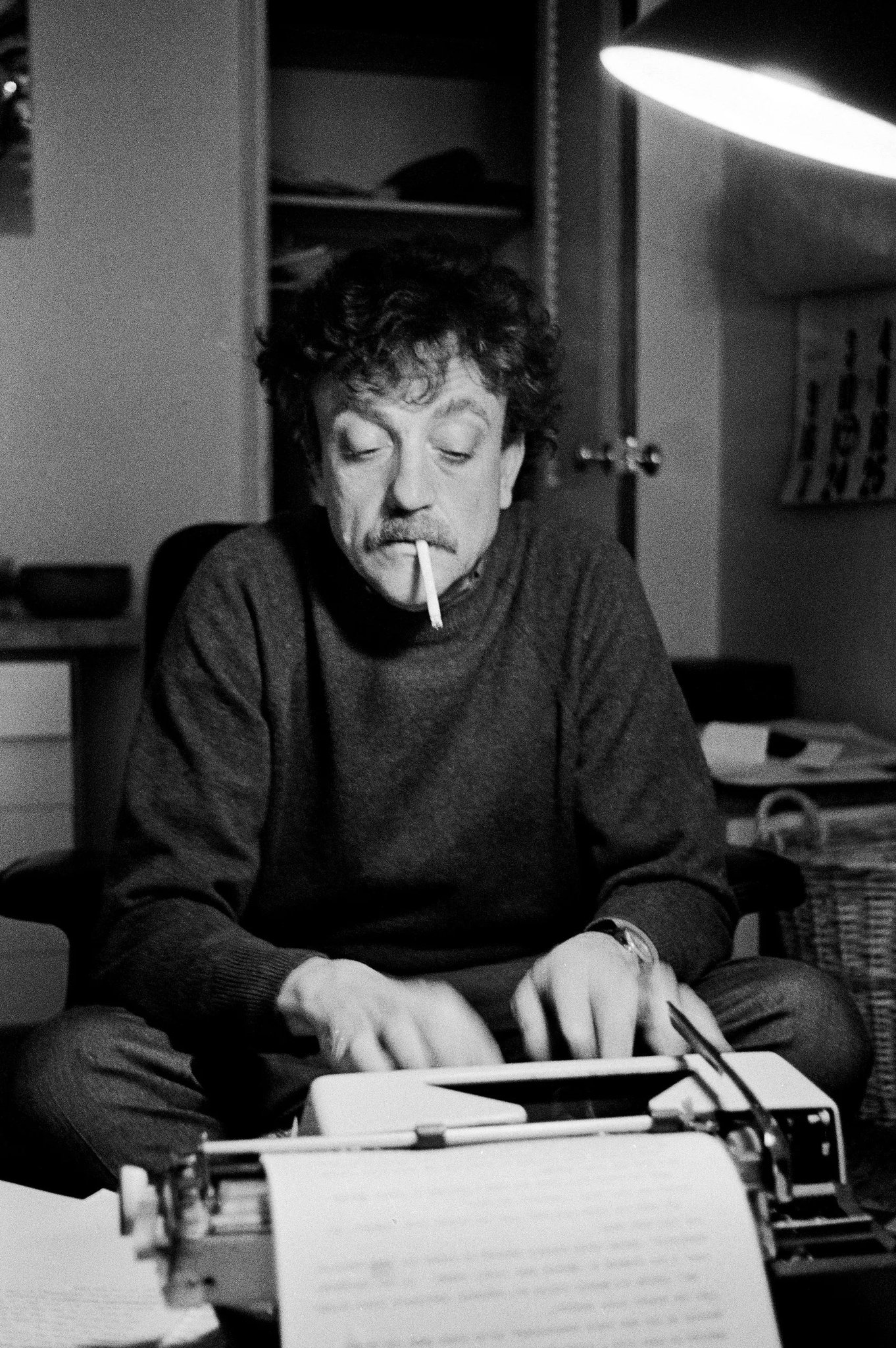
1. Use the time of a total stranger in such a way that he or she will not feel the time was wasted.
2. Give the reader at least one character he or she can root for.
3. Every character should want something, even if it is only a glass of water.
4. Every sentence must do one of two things—reveal character or advance the action.
5. Start as close to the end as possible.
6. Be a sadist. No matter how sweet and innocent your leading characters, make awful things happen to them—in order that the reader may see what they are made of.
7. Write to please just one person. If you open a window and make love to the world, so to speak, your story will get pneumonia.
8. Give your readers as much information as possible as soon as possible. To hell with suspense. Readers should have such complete understanding of what is going on, where and why, that they could finish the story themselves, should cockroaches eat the last few pages.
The Visual Rhetoric Unit
A Portfolio Assignment

The Visual Rhetoric Rewrite
- So far, we’re just a few items into your Portfolio collection.
- You’ve produced a Proposal+5 which will evolve into your Annotated Bibliography (That’s one Portfolio item).
- You’ve also produced a Definition/Categorical argument AND your Definition Rewrite, both of which could end up in your Portfolio.
- That said, you may be feeling rushed to produce arguments about your developing Thesis while you’re still gathering and examining sources.
- I’d like to give you a bit more time to work on those aspects of your research before you produce your Causal and your Rebuttal arguments.
- So . . .
- Let’s take a little detour and concentrate for a week or two on the Visual Rhetoric assignment, which will ALSO become part of your Portfolio.
- You’ll place your work directly into what we’ll call the Visual Rewrite.
- Unlike the Definition and the Definition Rewrite posts, you’ll have just one post for your Visual Rhetoric Unit.
WARMUP: Analysis of a Static Image
- To get warmed up to the idea of Visual Analysis, let’s start with a static image before moving on to motion pictures.
- Visual Rhetoric, Static Image
Visual Analysis of One Second of Video
Professor’s Model Analysis
0:01. The ad starts very abruptly in the middle of a scene. What’s more, in the first second, the camera is zooming quickly back so that we have to adjust immediately to a barrage of information. The suggestion the filmmakers are making is that the footage was captured by an amateur camera operator, either for home video or maybe a low-budget documentary. Either way, we are given the impression that the footage is “real,” not staged by a director with hired actors.
The image quality too is low. It’s color photography, but the color is so washed-out we get the further impression of a low-budget production. It’s almost black-and-white.
We are behind the counter of a diner. We can tell this from the “marble” countertop before us and the ketchup bottles and napkin holders on the shelf below it. Attached to the countertop is a familiar menu-holder empty of menus. Even closer to the camera (which suggests the footage was taken from the kitchen, through the service window) is a red-top bottle of Angustora bitters. Another can be seen on the counter where customers could access it, alongside the ketchup bottle and the sugar server. The only common use for bitters is as a cocktail flavor. The implication is that this is a diner where drinks are served; therefore, we have at least the implication that some diners might be drinking.
Facing us at the counter are two young boys (one black, one white) dressed in similar sport jerseys. They are probably teammates. Next to the white boy is a crew-cut man in his 30s with longish sideburns. If he were heavier, he would resemble Kevin James from “King of Queens.” The implication is that he is a robust, perhaps a bit rough-edged, working-class guy here with his team, perhaps their coach, maybe father to one of the kids. He wears a lanyard around his neck; perhaps a whistle hangs from it, and a warmup jacket: coachwear.
On the counter between him and the white boy is a fielder’s glove. They are a baseball team. The kid is not a catcher.
Behind the three at the counter, a man and a woman occupy opposite sides of a booth. They are engaged in conversation. The man resembles Joe Pesci from “Goodfellas,” advancing the impression that we’re in a working-class diner. The bowling pin behind him, part of the decor of the place, further confirms this. The lone framed artwork decorating the space is a black-and-white photo of an urban street scene. Coffee cups are stacked upside-down in the service area behind the woman, whose hand motion before her face indicates she is the one doing the talking.
They have been served. The man is pointing at something large on the white boy’s plate. In fact, he points at it repeatedly and says something about it to the boy. Most likely he is picking up the tab. Maybe he doesn’t want that big dish wasted.
From a filmmaker’s point of view, the composition of the figures is very important. The characters are arranged in a line. Black boy at counter, Joe Pesci facing Meg Ryan in booth, White Boy at counter, Meg Ryan in Booth facing Joe Pesci, Coach Kevin James gesturing with his hand toward White Boy’s plate. His active hand gesture draws our attention. When he stops moving, Meg Ryan starts moving her hand in the very same space, keeping our attention on that spot, but shifting our focus to the conversation she’s having with the Joe Pesci. In one second, we have information about two different conversations. Both are clearly important.
End of the first second.
Visual Analysis of a Complete Argument
- A Sample Analysis: Thai Life Insurance
- Here we examine just 10 seconds of a 2-minute long-form commercial produced by the Thai Life Insurance company to promote the universal human good of doing small selfless gestures for others. How in the world is that supposed to sell life insurance?
How Much (What Kind of) Detail?
- You won’t need this yet, but when you’re ready to revise your Visual Rhetoric argument, you may benefit from reviewing feedback I have offered to students in earlier semesters.
- Link to Revision Advice for Visual Rhetoric
Task
- Portfolio Assignment: Visual Rhetoric Rewrite
- DUE WED NOV 15 (11:59pm TUE NOV 14)


 Counterintuitive Fall 2024
Class Notes 10.23.24
I think what this mean is that you should summarize your paragraph into a sentence and then START with that sentence.
2/3
Class Notes 10/23/2024
The visual rhetoric assignment- You can make someone view an image differently based on how you caption it.
Ad council “Now”
Hypothesis – Summarize your intro paragraph to one sentence. Expand it only so far to develop your ideas in that sentence.
That’s pretty good advice for most paragraphs that seem to wander off topic. If they can be summarized, the summary is the main idea. Be sure to express that idea in one sentence, perhaps at the top of the paragraph.
3/3
Notes 10/23
*Helpful tips
Analysis of a static image
Yeah, that should work.
3/3
Class notes – figure8clementine
10/23/24
Very perceptive. Well described.
3/3
The way click baits work is that it’s a way to grab your readers attention, but it’ll only last for a quick second if the introduction doesn’t absolutely capture their undivided attention.
Advice from looking and analyzing examples of other classmates definition/argument is that to produce a thesis sentence is to summarized that paragraph into one whole sentence.
Given an assignment that is not relate to our research paper to take a step back, and come back to it later is a static image assignment. The assignment is to watch a thirty second video with no audio, and then analysis, and interpret what’s the significant of the video and why. Got to be well descriptive of what’s going on, and why.
How can the writers use the material to demonstrate their argument? It’s by knowing and understanding how effective the material can be used in a topic. Images are flexible based on how ones interpreted.
Sloppy phrasing but good understanding.
3/3
Class Notes- phoenixxxx23
-Our attention budget is getting smaller and smaller
-Start as close to the end as possible
-We want readers to feel confident in the author’s transitions
-Summarize your paragraph in one sentence -> develop this topic
-You can’t risk loosing readers because of your introduction paragraph
-Images are plastic and flexible, you can put any meaning inside them
-Provide background!
You certainly can, but you shouldn’t.
3/3
Class Notes 10/23
Start closer to your goal when writing, this will be easier to get your point across and leave out the unnecessary.
Kurt Vonnegut once said: Write to one person, that being your ideal reader. The reader should have such a complete understanding of what is going on that they could finish the the story if cockroaches ate the last pages.
Went over visual rhetoric argument assignment and how to anaylyze short videos in detail.
For example, if AI is dangerous, is it because knowledge is bad or because knowledge has always been misused to control the electorate until they can be fully disenfranchised?
3/3
Class Notes: 10/23/24
-Quote: The closer we start near the goal, the closer we get the reader to the goal of our argument.
-If we can’t figure out why our thesis is important, then it is not. This refers back to that we are not glued to our original argument.
-Narrow our focus of our writing to a certain reader
-Making our writing suspenseful is no use, give our readers all the information we have as soon as possible. Giving suspense just wastes our word count and makes us write blah blah blah.
-When books were first made, margins were made very wide because of mice eating the pages. Personally, this is just funny that people took into account that there are so many mice eating their books, so their solution was to waste more paper in order for the mice to eat it without hurting their work.
-The Visual Rhetoric Unit has nothing to do with our thesis/our argument, but is still a very important portfolio assignment that is due November 14th. The unit is just another literacy that will be useful for us to learn and understand.
-We will be doing a 30 second deep analysis of a visual; everything we include/ we see is important and deliberate.
-Do not have our readers wonder where we are going in our text. If there is no connection after 2-3 sentences, our readers are definitely going to be confused just like we were when reading the American Obesity writing. The best approach to fixing something like this is summarizing the paragraph into a sentence and then expanding as far as you need to, to get our point across.
-If we can’t summarize our idea in a sentence or two, our writing will be all over the place trying to find the main idea to bring together all of our previous sentences.
-When analyzing a visual argument from a film or video, we should describe what is happening in the video like we are telling a person who is blind what’s going on. This way we can describe the video well enough so that they do not have to watch it.
-The visual rhetorical is due Oct. 29th not Nov. 14th as the agenda said.
I love everything about these Notes, Taco.
5/3
Just read them again for the pure joy of hearing what you were thinking that day. 🙂
Thank you for making me feel significant.
10/23/24
What Happened:
Quote by David Mamet that my favorite professor just likes
List of things that must be done when writing
Why book margins were so big
The Visual Rhetoric Unit
Portfolio Assignment
President Transition from one into another
What I Got:
Claims should have motivation in them
Try to summarize a paragraph into one sentence
Combing resources for materials that is useful to you
What I still have Questions About:
Sketchy
3/3
10/23
Quote of the Day & Writing Tips
Visual Rhetoric and Analysis
The Obesity Epidemic…
Ad Council
I knew these Notes would be special as soon as I read this:
Not sure I could have explained the point of that quote any better.
5/3
Mongoose Notes – 10/23/2024
Visual Rhetoric
Sooo many extraordinary Notes on this particular day!
5/3
10/23/24
NOTES
Quote:
Writer
The Visual Rhetoric Unity
Core Value
Paragraph
Video
I don’t quite remember saying this, but I am suddenly passionate about the formula: 1st word narrows the universe, 2nd world reduces it to, say, a galaxy, 3rd world places us in our solar system, 4th word puts us on earth, 5th word locates us in time, 6 words in we should know what’s crucial about your thesis to humanity, now. Thank you.
5/3
Class Notes 10.23.24
I liked your Notes until I saw this:
Then I loved them. And thank you. And you’re welcome.
4/3
Class 10/23/24
By the time one paragraph is written your readers focus should be very narrow. Write to only the ideal reader and narrow that readers focus immediately.
Everything has a purpose. Make sure every word in your essay has a purpose. No word should be wasted.
Focus on one thing with the restriction of all others helps deepen the readers understanding and can help them notice things they otherwise would not have noticed.
Looking at the video in depth shows that we take in everything even if we don’t realize it. We are constantly making assumptions and analyzing things subconsciously which lead to larger, conscious assumptions.
Brief and extraordinarily perceptive. (Or am I just flattering myself when I hear what I meant spoken back to me? I hope not, but it’s possible.)
4/3
Class Notes 10/23
I could quote several of your Notes for special appreciation. I choose this one:
. . . and then our brain PROVIDES the context.
4/3
Notes 9/23/24
Nice
3/3
Class notes:
Really? What a lovely idea.
4/3
Class notes 10/23:
Quote: spend one paragraph going from this could be about anything at all to about something very specific, use one sentence summary to start then build upon it
The Visual Rhetoric Unit: morality plays, makes powerful argument to audience, use time stamps and description must be accurate enough to understand what is going on without actually looking at source, everything in the scene has meaning and a purpose, watch without sound
WARMUP: Analysis of a Static Image: The clear ones are useful, the vague ones are not, same material different meanings
Professor’s Model Analysis: Sections-describe visuals, why they are there, after analysis of effectiveness, does it match up with the sound
Visual Analysis of a Complete Argument: bars shown throughout the video, product being sold is life insurance for future happiness
Assignments:
Portfolio Assignment Visual Rhetoric OCT 29
Portfolio Assignment Visual Rhetoric rewrite NOV 14
These are mostly opaque to me, but nobody else mentioned this:
. . . which is very nice. So:
4/3
Class Notes 10/23
-We must know why our thesis is important or we are not passionate to our original argument
-Reader often skim over the reading so we must narrow our readers focus
-thesis statement summarizes the paragraph
-We can get our readers to come to a conclusion by evidence with directly stating it
-A reader must be able to describe the seen without listening to it and if they can’t then their is not a good enough visual description
OK
3/3
10/23
Rebel 🙂
4/3
Today we marched to a different beat, a change in rhythm from the usual topics about our thesis. Mostly.
The one exception was when we looked at material a student wrote for their definitional argument. Specifically, this student wrote about obesity, err-I mean, people who are exploiting others with misinformation about nutrition. I joke with my correction of what the student was writing about, because it gets to the heart of the lesson: we must be clear and concise about what our argument is. What we read, didn’t exactly cascade smoothly from one topic to the next. It instead read more like a lot of setup, or like list of topics that would be covered in the paper. A little bit of set up is not exactly a bad thing, however a summary of all the topics that will be covered is not what the first paragraph should be. Our first paragraph is to let loose the hounds of war and let our accusation fly. The rest of the paper we can lawyer together information we want people to see that supports our position.
The rest of the class was more distant from thesis stuff.
We talked about David Mamet’s advice. There isn’t much to comment about it. It is solid advice. It was what he found success in. Should we try to follow his advice? Yea, sure. I would summarize his advice in my own words as don’t be an erotic dancer with your writing. A stripper will tease and waste time and every time you think something is going to happen, nothing happens! Then like a slot machine, they ask if you want to pay more money for another go. Forget all that and get to the point! Give your audience the information it needs to understand the setting, the characters, and what is at stake for them. Then let the troubles out of pandoras box for the characters and give clear direction of where things are going. Get to the climax and make it a satisfying payoff so your audience doesn’t feel like they wasted time.
The real meat and potatoes of our class was about the meaning of images. We looked at an image of George W. Bush and Barack Obama at either ends of a spectrum, with several processed images that depicted strange interpretations of trying to fuse Bush and Obama’s face together. We were asked if this had meaning. If there was a meaning from the original creator of the image, it is not apparent. It appeared to me to more likely be a test of an AI’s ability to fuse images together. If we wanted to, the professor pointed out, we could put text to it and give it a meaning that we wanted. Man, did I want to call out “Like a meme?!”. Memes are America’s pastime, and this is literally how memes work! You start with an image and then everyone takes turns putting their own spin on it with text (or minor alterations to the image like putting a company symbol where someone’s face should be) to make if funny or make a statement.
We took a look at a YouTube video from the ad council about teaching boys to not hit girls, but without sound. It felt more like a lesson in cinematography than anything else: framing, camera movement, show-don’t-tell, and other concepts in the art of video making. Not sure what the takeaway was. I guess the takeaway was that people use filmmaking techniques to try to maximize the effect they want. We observed “shaky cam” (which has earned the ire of many film critics for being overused since the 2000s). We observed framing the person you want the audience to focus on by using color, objects, or just a zoom in. We observed show-don’t-tell, which showed us how the environment and costumes and character actions, tell us everything we need to know without the need for narrator or soliloquy.
The Writing Arts Department has faced up to the reality that much/most information today is communicated using a combination of text and visuals, so . . . literacy doesn’t mean what it used to mean (it never means what it meant a generation ago). Isolating the visuals from the audio/textural/video presentation is my way of emphasizing “digital literacy” by compelling students to convert visual information into text with the clear implication that for either to be predictably effective, BOTH must be deliberate and emphatically clear.
We know for sure the directors of the Ad Council videos made deliberate choices because they have the budget to get what they want. You should write as if you had thousands to spend on every second.
5/3
Class Notes – 10/23/24
Very perceptive critique.
4/3
Class notes 10/23
I love it when you tell my why and how class made a difference to you.
4/3
10/23
Good examples.
4/3
10/23
The quote of the day comes from David Mamet, a American playwright, who said , “The journey out always seems longer than the journey back. It is new and demanding, requiring furious concentration as we look for signs, characteristics, and shortcuts. On the return, we are better able to separate the essential from the extraneous; our concentration has been narrowed to the goal.” This profound saying resonates particularly well with those of us who struggle with extensive essays, whether it’s 3,000 words or even 10,000. In the face of such challenges, Mamet’s words serve as a comforting reminder that while the initial stages of a project can feel overwhelming, the process becomes clearer and more focused as we progress.
In our recent class discussion, we turned our attention to an upcoming assignment: a Visual Rhetorical unit. For this task, we will analyze a 30-second video, aiming to convey the perspective that the video intends to express. This involves a meticulous examination of every frame and second, allowing us to articulate how the visual elements contribute to the overall message. By dissecting the imagery and techniques used, we will gain insight into how the video is structured to engage its audience and convey its intended meaning.
A crucial question arises: how can writers effectively use the material to support their arguments? The answer lies in understanding the flexibility of images and their interpretations. Each visual element can evoke different responses, and it is the writer’s responsibility to harness these interpretations to bolster their narrative. By thoughtfully analyzing the video’s content and context, we can demonstrate how each component works together to reinforce the overarching message, ultimately enhancing our ability to persuade and engage our readers.
I would date this sentiment:
4/3
Class Notes 10/23
Brilliant Summaries, Skibidy.
5/3
Class Notes – 10/23
Not sure I know what you mean by either of these:
2/3
Class Notes 21 October 2024
Nice.
3/3